
Taco trucks have become a vibrant part of our culinary landscape, tantalizing our taste buds with each delicious bite. But just how much do these mobile eateries rake in annually? From the spicy satisfaction of birria tacos to the sweet indulgence of dessert trucks, revenues can vary significantly. In this flavorful journey, we’ll explore real-world income examples, daily sales estimates, and the vital difference between revenue and profit. Whether you’re a taco aficionado or an aspiring taco truck owner, understanding these financial aspects can help you navigate the rich world of taco ventures!
null
null
Real Revenue and Take-Home: What Daily Sales Reveal About a Taco Truck’s Annual Income
Estimating what a taco truck earns in a year starts with daily sales, then folds in location, hours, menu, and costs. A common range for annual sales in the United States is $200,000 to $400,000. Those figures represent gross revenue, not profit. Understanding how daily sales add up, and where money flows out, clarifies what an owner can realistically put in their pocket.
A simple way to convert daily performance into a yearly figure is to average sales per operating day, then multiply by days open each year. For a truck open every day, $200,000 translates to about $550 per day. At $400,000, that figure rises to around $1,100 per day. But many trucks do not operate seven days a week. A vendor operating five days a week, 50 weeks a year, needs daily sales of about $770 to reach $200,000, and roughly $1,540 for $400,000. Part-time trucks can still hit high revenue if they command strong weekday lunch crowds, lucrative events, and weekend markets.
Location drives the top line more than almost any other factor. High-traffic urban centers, entertainment districts, and busy commuter corridors can produce steady daily footfall. Market days, festivals, and catering contracts deliver concentrated spikes of revenue. Trucks that secure permits to park in premium spots can see daily sales multiply compared to trucks in lower-demand neighborhoods. Equally important is timing: dinner and late-night vending often yield higher average ticket values than weekday lunches.
Menu pricing and offer mix shape average ticket size. A tightly curated menu with a few high-margin add-ons will raise per-customer receipts. Upsells such as chips and salsa, specialty beverages, or premium proteins add $2–6 per order on average. Volume-focused vendors may aim for lower prices but faster throughput. Menu engineering—selecting items that sell reliably and deliver predictable food-cost percentages—lets owners forecast sales and margins with greater accuracy.
Operational efficiency tightens the gap between revenue and profit. Food cost, labor cost, and waste management are the biggest controllable expenses. A common cost structure for a mobile food business looks like this: cost of goods sold (COGS) around 25–35% of revenue, labor 20–30%, and combined fixed costs like insurance, permits, and loan payments taking another 5–10%. Fuel, maintenance, and marketing also eat into margins.
Profit margins for taco trucks often land between 15% and 30% when the business is well run. That means a truck with $200,000 in annual sales might clear about $30,000 in net profit at a 15% margin. At $400,000 of revenue and a 30% margin, net profit could be about $120,000. The spread depends on location, efficiency, staff management, and how many high-margin sales the truck generates. New trucks typically face tighter margins until they optimize routes, reduce waste, and build a loyal customer base.
To make the numbers tangible, consider three scenarios. First, a conservative full-time truck in a mid-sized city brings in $200,000 a year. With COGS at 30% and labor at 25%, plus fixed costs totaling 10%, net margin lands near 15%, or about $30,000. Second, a well-placed truck in a busy metro area reaches $300,000. With better purchasing and efficient shifts, margins improve to about 20%, yielding roughly $60,000 profit. Third, a high-performing vendor that combines events and catering with street vending clocks $400,000. Strong menu engineering and lower waste push margins to 25–30%, producing $100,000 or more in net income.
Some specialty vendors exceed typical ranges. A truck that focuses on a niche product, targets high-value events, or operates in an affluent, tourist-heavy location can surpass the $400,000 mark. Conversely, trucks in saturated markets or those unable to secure premium spots often struggle to reach the lower end of the typical range.
Costs that commonly surprise new owners include permit fees, commissary or kitchen rental, and insurance. Commissary fees for a shared kitchen can be several hundred dollars per week. Insurance for a mobile food business, along with vehicle maintenance and regular safety inspections, adds recurring expenses. Fuel and vehicle wear also fluctuate with route length and number of stops. These predictable costs must be folded into weekly and monthly budgets to avoid cash-flow shocks.
Increasing daily sales and protecting margins requires both operational discipline and marketing. Operational steps include tightening portion control, negotiating better supplier contracts, and refining prep to reduce waste. Cross-selling and menu combos raise average order value. Building a pipeline of private events and catering work fills slow days and creates predictable revenue. On the marketing side, a consistent outreach strategy boosts repeat business. One practical resource for growing return customers is a focused email program; many vendors find success using targeted campaigns to promote specials and event appearances. Learn more about effective approaches to customer outreach with this guide to email marketing for food trucks.
Daily sales are also shaped by staffing. Short, skilled shifts minimize labor costs while maintaining service speed. Training staff to upsell and to work tightly as a unit improves throughput at peak times. Many owners reduce payroll strain by working shifts themselves during busiest windows and hiring part-time help for large events.
Finally, measure and iterate. Track daily sales by location, time, and menu item. Calculate average ticket size and conversion rate for each shift. Use those numbers to test changes in pricing, menu offerings, and placement. Small gains in conversion or average ticket size compound quickly over a year.
Daily sales estimates give a clear path to annual revenue, but the real business question is take-home pay. With disciplined cost control and smart marketing, a taco truck that posts $200,000 to $400,000 in sales can generate a reliable small-business income. The exact figure depends on how effectively the owner manages costs and grows high-margin sales. For more detailed industry data and guidance on small food-service businesses, refer to the U.S. Small Business Administration report: https://www.sba.gov/business-guide/plan-your-business/industry-research
What Taco Trucks Really Earn: Side-by-Side Annual Revenue Comparisons
A realistic look at annual revenue and what those numbers actually mean.
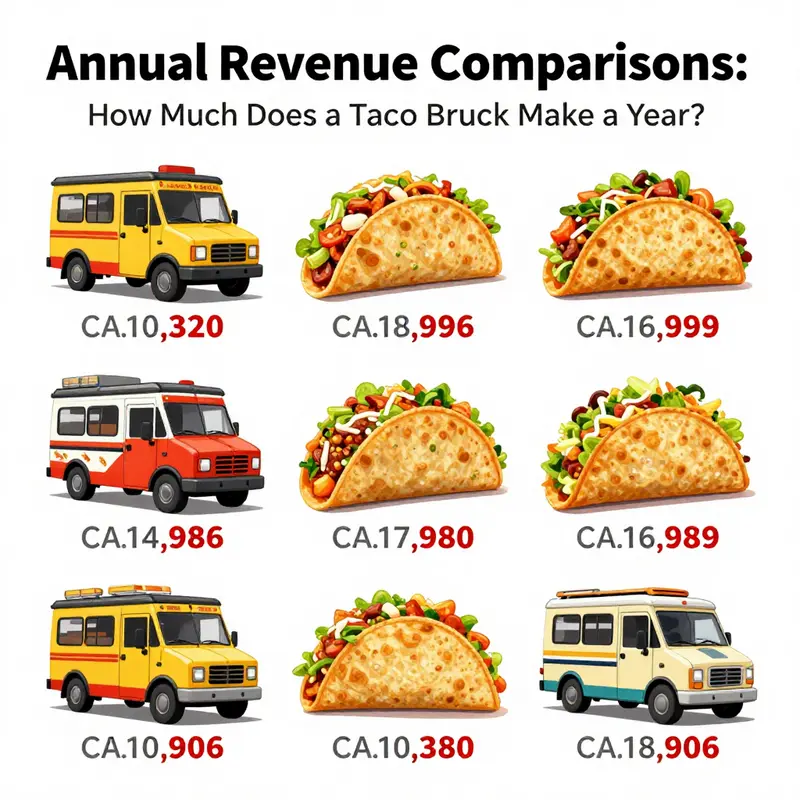
When people ask how much a taco truck makes in a year, they often expect a single neat figure. The truth is a range. Gross revenue for mobile food businesses varies widely depending on concept, location, operating days, and scale. Three illustrative examples show this clearly: a mid-sized taco truck selling mainstream tacos reported roughly $10,000 AUD per month (about $120,000 AUD annually), a dessert-focused truck operating two days a week reported about $250,000 AUD a year, and a long-established kebab operation with multiple locations tops $1,000,000 AUD in annual turnover. Those figures represent revenue, not profit, and that distinction matters.
Revenue is the starting point of any financial conversation. It’s the total money taken from customers before costs. Profit is what remains after every expense, and for food trucks those expenses can be substantial. Kitchen rental, vehicle maintenance, fuel, insurance, permits and licenses, staff wages, food cost, packaging, and marketing all chip away. Many trucks also invest in a commissary or shared kitchen space, which adds recurring rent but often lets operators produce at higher volume or meet local regulations.
How can a truck that operates only two days a week reach higher annual revenue than a daily taco truck? The difference comes down to context. A dessert truck that serves high-margin items at premium events, festivals, and private bookings can command higher per-customer spend. That truck might charge more per item and sell at locations where foot traffic and willingness to pay are substantial. Conversely, a weekday taco truck based near an office precinct may sell lower-priced items more frequently, producing steady revenue but lower per-unit margins. Volume and margin interact: higher price times lower volume can equal lower price times higher volume.
Another key factor is event strategy. Night markets, festivals, and corporate bookings concentrate many customers into short time windows. Some operators report daily takings at markets in the range of $1,500 to $2,000 AUD, and with frequent market bookings that scales up quickly. A truck that secures a reliable roster of weekend festivals can earn the equivalent of full-time revenue working fewer days. Meanwhile, trucks that rely on street corners or food hubs must balance consistency with daily overheads.
Scale and footprint matter too. A single truck has different economics than a multi-unit brand. The long-established kebab operation with several locations benefits from brand recognition, repeat customers across sites, and operational efficiencies. Multi-location operators spread fixed costs over more revenue, negotiate better supplier pricing, and optimize staffing. A single-truck operator has lower fixed overhead but fewer levers to reduce cost per sale.
Location makes or breaks revenue potential. Serving a high-traffic urban precinct, near a university, at a busy nightlife strip, or at large events changes customer mix and average spend. Customer demographics also influence menu design and pricing; a college crowd may favor budget-friendly combos while a markets crowd might choose premium or innovative options. Strictly comparing two revenue figures without context can be misleading: $120,000 AUD in one suburb might reflect a sustainable, profitable operation, while $250,000 AUD in another context might still deliver slim margins after costs.
Menu complexity affects both revenue and costs. Simple menus with a few high-margin items speed service and reduce food waste. Complex menus increase ingredient variety and preparation time, often requiring more staff and larger prep facilities. Dessert offerings that use premium ingredients can justify higher ticket prices. Similarly, signature dishes that draw loyal customers create pricing power, which directly impacts revenue potential.
Operating days and hours also shape annual revenue. A truck open daily must manage consistent supply and labor costs. One that concentrates on weekends and events may reduce some fixed expenses but face greater variability in weekly income. Some owners combine strategies: weekday lunchtime in office areas and weekend festivals or private events. That hybrid model smooths revenue across the week while exposing the operator to different customer segments.
It’s important to translate revenue into practical expectations. Typical cost breakdowns for a mobile food business often include food cost (25–40% of sales), labor (20–35%), and other operating expenses (15–30%). Combined, these can leave net profit margins that vary widely—from single digits for highly competitive low-margin operations to healthy double digits for niche businesses with premium pricing, tight cost control, and strong repeat business. A $250,000 AUD revenue figure might yield a modest living wage after expenses or a robust profit, depending on those margins.
Financial management and tax strategy influence the bottom line too. Proper bookkeeping, claiming allowable deductions, and understanding depreciation of equipment reduce taxable income and protect cash flow. For operators looking to optimize their numbers, understanding common tax deductions specific to food trucks can make a measurable difference. A short guide on food truck tax deductions offers practical advice to reduce tax liability and preserve working capital: food truck tax deductions.
Beyond costs, growth potential depends on reproducibility and brand. A concept that travels well—healthy bowls, distinctive tacos, or memorable desserts—can expand through additional trucks, permanent kiosks, or wholesale distribution. But scaling requires capital, systems, and management bandwidth. Many growth plans fail because operators underestimate the complexity of managing multiple units or lose quality control as they expand.
When evaluating a reported revenue figure, always ask clarifying questions: Is that gross sales or net profit? How many days per week does the truck operate? Does the operator pay rent for a commissary kitchen? Are staff wages included? How much is spent on fuel and maintenance? The answers reveal the sustainability of the business model.
In practical terms, a realistic annual revenue band for mobile food businesses often spans from under $100,000 AUD for smaller, part-time operators to over $1,000,000 AUD for multi-location, high-volume brands. Most straightforward, single-unit trucks aiming for full-time income tend to target a revenue floor that supports wages and reinvestment—often in the mid five-figures to low six-figures. The most important takeaway is that revenue alone doesn’t tell the full story. Profitability depends on disciplined cost control, smart location choices, pricing strategy, and the ability to capture high-value bookings or repeat customers.
These comparisons show what’s possible and what to watch for. Treat revenue figures as signals, not guarantees. A food truck can earn from modest to substantial sums, but turning top-line sales into reliable profit requires planning, cost awareness, and operational focus.
Source: https://www.news.com.au/technology/tech-news/food-truck-revenue-australia/news-com-au/taco-truck-makes-10000-a-month-how-much-do-food-trucks-really-make/news-story/c9d4a637f3e8e3b4c7e9c4e5d6a5c5d6
From Turnover to Take-Home: Decoding How Much a Taco Truck Really Makes in a Year
People often ask how much a taco truck makes in a year. The truth is nuanced. The best available figures show a wide range, driven by model, location, and season. For example, a birria-focused truck in a busy market might post annual revenue near the six-figure USD, a night-market operator could reach six figures with disciplined pricing and strong locations, and a dessert truck with limited hours can still generate substantial revenue if demand stays robust. Importantly, these numbers reflect revenue, not take-home profit, because costs—kitchen rent or space, vehicle maintenance, fuel, insurance, permits, staff wages, ingredients, packaging, and marketing—eat into the gross.
To understand the real picture, separate revenue from profit. Revenue is the total money taken in for tacos and sides; profit is what remains after paying for all operating expenses. A truck might generate $300,000 in annual revenue but only net around $50,000 in profit if costs are high. The gap between revenue and profit highlights financial health and depends on pricing, efficiency, and scale. In practice, margins matter more than top-line turnover because they determine how long the business can fund upgrades, weather slow periods, and reinvest in people or equipment.
Industry benchmarks vary by market. In the United States, a typical net profit margin for a small food-truck operation has hovered around 8% to 12%, translating to roughly eight to twelve cents of every revenue dollar as profit. In high-demand urban zones with premium pricing, margins can edge above 15%. In less populous or highly seasonal markets, margins can dip below 5%. These figures assume ordinary overheads—ingredients, labor, maintenance, permits, and marketing—are aligned with industry norms and do not account for extraordinary expenses or special promotions.
Several levers shape both revenue and profit. Ingredient quality, menu identity, and pricing discipline matter; a focused offering can justify higher prices and build loyal customers. Location strategy matters: proximity to offices, transit hubs, events, or festivals can turn a slow street into a revenue hotspot. Marketing, especially via social media, can convert occasional customers into regulars. On the cost side, skilled operators negotiate favorable supplier terms, forecast accurately to minimize waste, and keep vehicles reliable to avoid downtime. Diversification—catering for events, selling bottled sauces, or offering branded merchandise—can broaden revenue streams without needing a bigger truck.
The math from practical experience suggests a realistic range. For a mid-market scenario, annual revenue might be AUD 300,000 to 400,000. At an 8% to 12% net margin, take-home profit would be roughly AUD 24,000 to 48,000 per year. If margins approach 15% or higher due to efficiency or premium pricing, profits can push toward AUD 45,000 or more within the same revenue band. This swing matters because it determines how quickly a business can fund upgrades, training, or expansion and whether strong top-line figures translate into lasting profitability.
Finally, thoughtful planning matters as much as sales intake. Map expected daily or weekly sales, set prices that reflect value, and build a calendar of events to sustain cash flow. Use simple tracking to capture ingredient costs, labor, and maintenance so you can spot leaks and identify where improvements yield the biggest impact. A disciplined approach to purchasing, waste reduction, and maintenance is not optional—it’s the hinge on which profitability turns. In the end, the question is not only how much a taco truck can make, but how reliably it can convert revenue into meaningful profit over time.
Final thoughts
Navigating the taco truck landscape requires an understanding of the financial dynamics at play. While the delicious aroma and flavors of tacos can bring in enticing revenues, the reality lies in managing expenses and discerning profit from mere revenue. By exploring monthly incomes, daily sales estimates, and diving into profit margins, taco truck enthusiasts and entrepreneurs alike can make informed decisions for success. Keep these insights in mind as you embark on your taco journey—whether you’re savoring the flavors or serving them up in your own truck!