

Picture this: the tantalizing aroma of sizzling meats, fresh tortillas, and vibrant toppings swirling through the air. Taco trucks are not just a feast for the senses; they’re also a flavorful business opportunity! Understanding how much taco trucks make can empower food lovers and aspiring taco entrepreneurs alike. From bustling city streets to popular festivals, taco trucks can generate varying revenue based on a multitude of factors. This article will dive into the heart of the taco truck business, exploring the revenue potential in high-traffic areas, analyzing operating costs that affect profitability, examining how customer volume influences daily sales, and assessing startup costs and ROI. Let’s taco ‘bout the numbers and uncover the potential that lies within every taco truck!
Cash, Miles, and Crave-Worthy Tacos: Reading the Revenue Potential of Taco Trucks in High-Traffic Urban Hubs

The allure of the taco truck is not merely in the aroma of peppers and the sizzle of a busy griddle. It rests in a pattern of cash flow that can look deceptively simple on a chalkboard: grab customers, sell bites, repeat. Yet the actual equation of revenue for taco trucks in high-traffic urban areas is a tapestry woven from location, timing, menu pricing, customer flow, and the discipline of operations. The numbers that circulate in industry reports are both reassuring and humbling. In peak, high-traffic environments—downtown business corridors, near stadiums and entertainment districts—the doors swing open to a stream of hungry people. On those days, daily gross can range from roughly one thousand five hundred dollars to three thousand dollars or more during peak hours. Multiply by a typical month with a blend of busy and slower days, and it becomes clear why some trucks command substantial monthly top lines. In fact, when a truck thrives in a prime location with consistent hours and strong branding, annual revenue can exceed half a million dollars, and for the most persistent performers it can reach well beyond that mark. Still, those figures sit on a spectrum. They represent what is possible under certain conditions, not a universal guarantee.
If a reader looks beyond headline numbers, a more grounded picture emerges. A well-managed operation in an urban pocket often reports revenue in the range of twenty thousand to fifty thousand dollars per month. This ceiling is not merely about selling more tacos; it is about tuning every lever of the business to generate volume, while controlling the drain on the bottom line. The lower end is not a failure; it is a function of a truck that may be newer, in a less consistent location, or operating with more restrained hours. The upper end is a story about schedule, speed, and a loyal following that knows where to find the truck and when to show up. The spectrum reflects the reality that the taco truck is a mobile business that thrives on the ability to chase demand while managing costs that can swing with the day’s rhythm.
The revenue conversation cannot ignore the simple math of pricing and volume. An average meal price in the range of six to twelve dollars anchors a typical transaction, though some menus fetch higher prices for specialty toppings, premium proteins, or combo deals. In a bustling neighborhood, a well-balanced menu may move through two hundred or more customers in a single day, especially when the truck is present for lunch and then returns for dinner or later shifts around events. Those headcounts translate into daily gross that ladders up to meaningful monthly totals, but the math of profit hinges on cost control as much as sales velocity. A rule of thumb that recurs in reports across the industry is that food cost often lands around thirty to forty percent of revenue. Add in the costs of fuel, labor, permits, insurance, and ongoing equipment maintenance, and the net monthly profit tends to land somewhere in a broad band—from roughly five thousand to fifteen thousand dollars—depending on location, efficiency, and how well management squeezes out productivity.
In practice, the reality of revenue is often a balance between the intensity of peak hours and the discipline of day-to-day operations. Prime urban locations—places that draw a steady stream of foot traffic, such as downtowns, close to office clusters, near sports venues, or inside popular entertainment districts—are especially potent. The trucks that perform best there leverage multiple shifts. A common pattern involves a lunch service followed by a dinner push, sometimes with a brief late shift on busy evenings or during events. The ability to serve more customers without a dramatic increase in fixed costs is one of the core advantages of the mobile model. It is easier to scale throughput by adding hours or days than it is to scale fixed overhead in a brick-and-mortar setting. This flexibility further amplifies the revenue potential in high-traffic corridors, where demand can surge in concert with holidays, game days, concerts, or citywide events.
From a practical vantage, the revenue narrative in these high-traffic zones also rests on the speed and quality of service. A truck that processes orders rapidly, maintains consistent portioning, and keeps its lines moving will capture more customers with less friction. Speed is a form of capital in the street-food economy. When customers are hungry and time-starved, the value of a short wait and a reliable, satisfying bite goes beyond the immediate transaction; it builds trust and repeat business. In this sense, the revenue potential is not just about the size of the crowd but the crowd’s willingness to return, recommend, and follow the truck to new locations. The social dynamics of mobility—where a truck appears on social feeds or in live check-ins—can transform a single day of sales into a week’s worth of foot traffic, adding a multiplier effect that is hard to quantify in a single metric.
The point here is not to paint an overly optimistic portrait, but to acknowledge the dynamics that drive revenue in these mobile kitchens. The same urban energy that can power a surge in sales also carries variability. Weather, transportation noise, competing food options, and regulatory constraints shape the range of outcomes. A truck may ride a wave of lunch-hour crowds for a few weeks, then face a slower season or a change in event calendars. Seasonal trends may create pronounced peaks in spring and summer when outdoor activity is at its height, while winter months can compress demand in some markets. The adaptability of the operator—adjusting routes, timing, and even menu rotation to align with demand—becomes a critical determinant of sustained revenue.
Though the headline case studies—cities like Los Angeles, New York, and Chicago—often highlight impressive revenue figures, the practical decision to operate a taco truck rests on a sober assessment of costs and cash flow. Startup costs to acquire a vehicle, outfitting a kitchen, obtaining licenses and permits, and stocking initial inventory can range widely—from roughly forty thousand dollars up to a hundred thousand dollars or more, depending on vehicle condition, kitchen capacity, and compliance requirements. Those startup costs shape the return on investment timeline and underline why many operators segment their early years into phases: building a brand, filling calendars with repeat customers, and then expanding presence to new neighborhoods or events.
With these economic contours in mind, it is useful to reflect on the broader picture: a high-traffic urban taco truck can do more than satisfy a hungry crowd. It can create a portable brand, a micro-restaurant engine, and a flexible platform for growth. The objective for most owners is not simply to maximize daily sales but to sustain a profitable cadence over time, balancing revenue opportunities with the inevitable costs and risks of street commerce. The narrative of profitability increasingly rests on two pillars. First, a deliberate location strategy that locates the truck where demand clusters and where the truck can operate under predictable hours with manageable competition. Second, a disciplined operations playbook that minimizes waste, maintains food quality, and optimizes labor and supply costs without compromising service speed or guest experience. When those pillars align, a taco truck in a busy urban setting—armed with a clear menu, a loyal following, and a smart marketing approach—can convert vibrant foot traffic into dependable cash flow.
To those who want a more tangible map of how to approach this, there is value in looking at the models behind the scenes. The most successful operators often study the paths that other thriving trucks have taken, understanding what has enabled them to sustain volume over time. For readers exploring the best structural choices in the business, a compact reference point can be found in curated guides that detail top food truck models for success. top food truck models for success offers a concise sense of how equipment configurations, kitchen layouts, and mobility strategies contribute to performance in crowded markets. That resource emphasizes how the combination of a capable vehicle, an efficient kitchen, and a coherent operational plan translates into reliable day-to-day revenue and stronger margins over the life of the business.
Bringing these considerations together, the profit story for high-traffic taco trucks is not a single numeric forecast but a dynamic forecast. It depends on the interplay between the market’s appetite and the operator’s ability to convert appetite into orders with minimal friction. It depends on the daily discipline of keeping costs in check, the savvy use of social channels to steer foot traffic, and the agility to reposition the truck when demand migrates. It depends on the entrepreneur’s willingness to invest in branding, maintain a clean and efficient kitchen, secure the necessary licenses and insurance, and adopt a pricing strategy that reflects quality, portion size, and the value offered to customers who are deciding where to spend their limited lunch hour or evening entertainment budget. In those conditions, a taco truck’s revenue potential in high-traffic urban areas is not just a function of luck or a single strong day. It is the product of a calculated routine that treats every hour on the street as an opportunity to convert curiosity into repeat visits and every month as a stage on which a dependable, scalable business can develop.
Finally, the economics of the taco truck must be understood alongside the realities of cost control. Food costs, typically a slice of thirty to forty percent of revenue, matter as much as the revenue itself. Labor costs, fuel, maintenance, and permits add layers of ongoing expense that eat into gross. Insurance and health compliance require attention and investment, while equipment maintenance—keeping the stoves, refrigeration, and power systems reliable—prevents expensive outages that can disrupt service and damage margins. Even with higher revenue potential, poor cost management can erode the bottom line quickly. A truck that can sustain a robust cadence of 200-plus customers per day, with an average ticket of eight to twelve dollars, will see a healthy gross per day, but it is the ratio of costs to this gross that will determine net profit.
The broader lesson for readers considering whether to launch a taco truck in a high-traffic market is that profitability is a function of deliberate choices as much as market conditions. The better the operator is at selecting locations, managing shifts, pricing strategically, and controlling costs, the more consistently the business can produce solid margins. This is especially true when the truck leverages the flexibility of mobile service to chase demand. The very mobility that makes the business adaptable can also be its strongest asset when managed with a continuous improvement mindset—testing new routes, optimizing restocking, and aligning promotions with local events. In short, the revenue potential exists in the interplay between street-smart operations and market opportunity, and the chapter’s data points—ranging from peak daily gross to annual revenue potential—reflect the wide spectrum of outcomes that skilled operators often navigate.
For readers seeking a bridge to practical decision-making, the takeaway is clear. If you are contemplating whether to enter the taco-truck segment or to scale an existing operation in a bustling city, you should not only assess the top-line revenue you could theoretically achieve but also conduct a careful projection of your costs and a realistic plan for how to capture demand across different times and places. The real-world finance of street-food ventures rewards those who plan for both intensity and cadence: intensity in peak selling moments and cadence in steady, repeatable operations. The path to profitability is not a single move but a sequence of optimized decisions—where to park, when to serve, how to price, and how to steward costs while maintaining quality that keeps customers coming back. In this sense, the revenue potential of taco trucks is a practical, navigable target rather than an abstract ideal; it is a map that unfolds as you align your truck’s location, hours, and menu with the rhythms of the city streets.
External reference for deeper case studies and real-world financial performance can be found in industry reporting and professional analysis. For a detailed, real-world perspective on taco truck revenue and earnings, see The Street’s analysis: https://www.thestreet.com/small-business/restaurant-business/taco-truck-revenue-earnings-15179368
Profit Under the Hood: Decoding Taco Truck Earnings Through Operating Costs
When people ask how much a taco truck makes, they often focus on revenue as if that figure alone were the bottom line. Yet the true picture emerges only after you pull back the curtain on operating costs. In Canada, as in many markets, revenue potential sits on a steep hillside of variables—location, customer flow, pricing strategy, and the unique economics of running a small kitchen on wheels. The numbers from recent analyses tell a plausible story: a well-placed, efficiently run taco operation can pull in substantial gross revenue, but the margin between that revenue and what actually lands in the owner’s pocket is determined by a careful balance of fuel, maintenance, insurance, labor, permits, and ingredient costs. The result is a range of outcomes rather than a single, clean figure, with profitability hinging on how well a operator manages the daily rhythm of a mobile kitchen and the longer arc of the business’s strategic choices.
The Canadian data sketch a vivid portrait of what it takes to convert high potential into steady profit. On the revenue side, a popular taco truck in a busy urban setting may generate a strong daily gross income. The best-performing units in peak locations can see daily totals that approach or surpass the $1,500 to $3,000 CAD band, translating into roughly $45,000 to $90,000 CAD in gross revenue per month if the truck operates consistently across a typical month. That top-line potential is real, and it’s amplified by branding, a reliable team, and a menu that resonates with local tastes while maintaining efficient preparation. But the flip side—operating costs—carries significant weight. Monthly costs commonly fall into a broad band, reflecting the still considerable scale of a mobile kitchen’s needs: fuel to power the vehicle and equipment; ongoing maintenance to keep a secondhand or vintage chassis safe and reliable; insurance to cover a commercial vehicle and a small kitchen crew; labor costs for a compact team; and permits or zoning fees that ensure the truck can park and operate legally in chosen neighborhoods or event spaces.
From a practical standpoint, the Canadian framework presents a cost palette that is both predictable in its categories and variable in its magnitudes. Fuel, the simplest recurring expense, often represents a noticeable share of monthly outlays. Because many Canadian food trucks operate larger, heavier configurations to house more robust cooking equipment, diesel fuel consumption can be higher than for smaller urban carts. A typical estimate places fuel costs in the range of CAD $1,000 to $2,000 per month depending on mileage and route density. Maintenance and repairs follow closely behind, especially for trucks with older or retrofitted kitchens. Annual maintenance can accumulate to CAD $3,000 to $6,000, which works out to a modest monthly expense when spread across the year but can spike in months when major service work is required. Insurance for a commercial vehicle is another essential line item, often running CAD $1,200 to $2,000 per month, driven by coverage levels, claims history, and local risk factors. Labor, the hourly heartbeat of the operation, typically occupies the largest slice of the ongoing budget, with a two-person team (driver/owner plus kitchen staff) ranging from CAD $4,000 to $7,000 per month, depending on local wage norms, hours, and overtime. Then there are permits, zoning fees, and parking or event access costs that can add CAD $300 to $1,000 per month, depending on the city’s density and the types of events the truck targets.
Even when these numbers are added together, they do not tell the entire story. Food costs themselves—essential to any food business—tend to consume a sizable share of revenue. Across many taco concepts, ingredient costs run roughly 30% to 40% of revenue. That is a critical lever in the profitability equation: the tighter the control over food costs, the higher the net potential, even when gross revenue remains constant. In practice, this means a chef’s eye for menu engineering, supplier relationships, and waste management can have outsized effects on the monthly bottom line. For operators who master portion control, negotiate favorable terms with local suppliers, and design menus that minimize waste while maximizing speed of service, the net result can meaningfully outpace less efficient peers, even when gross revenue sits in the same range.
Taken together, these layers of costs and revenue shape the often-cquoted expectation that net monthly profits from a Canadian taco truck can land in the CAD $15,000 to $35,000 range. It is a broad band, but it captures the essence of the trade-off: strong traffic and a lean operation can deliver substantial profit, while higher fuel costs, greater maintenance needs, or a heavier labor footprint can compress margins. The upper end of the range presumes efficient scheduling, high-volume traffic in favorable spots, and disciplined cost management, while the lower end reflects the normal friction of urban life—parking constraints, weather disruptions, and the variability of event calendars. It is important to emphasize that this is not a guaranteed, linear outcome. It is a spectrum shaped by the truck’s location, the cadence of the workweek, and the operator’s ability to optimize both front-of-house throughput and back-of-house cost control.
A practical way to understand the math is to connect revenue potential with cost inputs in a simple but realistic frame. Suppose a well-located truck draws consistent traffic and maintains a daily gross around CAD $2,000. If the truck operates 25 days in a month, gross revenue would total roughly CAD $50,000. From that, variable food costs, assumed at 35% of revenue, would be CAD $17,500. That leaves approximately CAD $32,500 to cover fixed costs such as labor, fuel, maintenance, insurance, and permits. If labor consumes CAD $5,500, fuel CAD $1,500, maintenance CAD $350 (averaged out), insurance CAD $1,500, and permits CAD $700, the total operating expenses would be around CAD $9,550 on top of the still-uncaptured food cost share. The resulting net figure would be in the vicinity of CAD $22,950 for the month—well within the mid-to-upper portion of the stated profitability band, and a reminder that profitability is a function of not just revenue but the discipline of operating costs. In more frenetic urban markets with higher rents for permits and more intense competition for parking and event access, the same daily revenue might face higher fixed costs, compressing monthly net toward the lower end of the range. Conversely, a truck that figures out how to lower fuel burn through route optimization, or squeezes more efficiency from its equipment, could push the bottom line higher even with a similar top line.
The numbers also illuminate the importance of seasonality and the cadence of opportunities. In Canada, winter months can temper traffic and demand, while summer and fall bring a different rhythm with outdoor events, farmers’ markets, and street-festival circuits. A business modeled around steady daily operations in a fixed location may experience steadier cash flow, whereas a truck that pivots toward events, catering gigs, and off-peak times can create a more nuanced revenue profile. One recurring theme across successful operators is diversification: some trucks build a portfolio of revenue streams, such as catering for small corporate gatherings or school events, in addition to their street-side sales. This approach can smooth out the bumps of seasonality and lock in more predictable revenue across the calendar year. It also aligns with the general principle that a taco truck is not only a source of daily meals but a mobile business platform with the flexibility to pursue multiple streams of demand.
With that in mind, the profitability story in Canada is not purely a function of the truck’s price tag or the size of the kitchen inside. It is a function of how the operator designs the business around a given location, a given customer base, and a given set of constraints and opportunities. The initial investment in the vehicle, kitchen equipment, licenses, and initial inventory—often a substantial upfront cost in the CAD $50,000 to $150,000 range—plays into return-on-investment calculations. Some operators break even within roughly 12 to 18 months, while others achieve profitability faster by optimizing operations and leveraging branding that translates into higher price tolerance and repeat customers. This is where the choice of vehicle form and kitchen workflow intersects with economics: larger, better-suited spaces may improve throughput and quality, but they can also elevate depreciation and insurance costs. In contrast, smaller, simpler configurations reduce upfront risk and ongoing expenses but may limit menu breadth and service speed. The art of balancing these trade-offs becomes central to the chapter of the business that concerns itself with operating costs and net earnings. It is a dynamic, ongoing calibration rather than a one-time decision.
Beyond the core cost categories, there are operational practices that can meaningfully shift the profitability dial. Energy efficiency, for example, can reduce both electricity and fuel consumption. Upgrading to energy-efficient appliances lowers utility costs and can also improve reliability during busy service windows. Efficient route planning minimizes unproductive mileage, a factor that feeds directly into fuel costs and maintenance wear. Menu engineering—crafting a compact, high-margin menu with a handful of signature items—protects gross margins by reducing waste and simplifying inventory management. The more a truck can deliver with fewer SKUs, the easier it becomes to forecast demand, manage food costs, and avoid overstocking. In practical terms, this means focusing on a handful of crowd-pleasers that travel well, that can be prepared quickly, and that can be scaled to accommodate sudden surges in demand during peak hours or events. Branding and customer relationship management also matter. A strong brand—consistent visual identity, clear value proposition, and reliable service—can justify price premiums and foster repeat business, two levers that directly support healthier net profits. For operators who invest in a lean, well-branded operation, the long arc of profitability becomes clearer, even as month-to-month fluctuations remind us that the market remains unpredictable.
Another layer of strategic thinking involves the cost of capital and the financial structure of the business. Startup costs, financing terms, and depreciation schedules all influence the apparent profitability in any given month. For example, a truck financed with favorable terms reduces cash outlay in the first year and improves short-term net income, even if the underlying economics of food and labor remain constant. Conversely, a high-interest loan or aggressive lease structure can erode margins and stretch the time to profitability. Operators often overlook this dimension when glorying in high daily revenues; the debt service or lease obligations must be serviced in good months and bad. The best performers treat these financial charges as a fixed cost of doing business that must be covered by steady income, or they mitigate risk with reserve funds and diversified revenue streams that reduce reliance on a single source of demand.
A final, practical takeaway is the role of information and reference points in decision making. Operators benefit from looking at market benchmarks, not as strict rules but as gauges of performance. For those exploring the broader economics of food trucks, credible benchmark reports provide context for the numbers—how costs trend over time, how consumer demand responds to pricing, and where the pressure points typically lie. In Canada, recent industry benchmarking highlights how pivotal strategic location and cost discipline are to sustaining healthy net profits, especially when fuel and labor markets shift. For readers who want a more in-depth, data-driven look at the economics behind food trucks, there is a formal benchmark study that compiles these dynamics across multiple markets and can serve as a practical reference point for budgeting and planning. You can explore the official Canadian Food Truck Association’s 2026 benchmark for a structured view of these dynamics: https://www.canadianfoodtruck.org/reports/2026-food-truck-economic-benchmark. In the meantime, the practical lesson remains: understand your operating costs inside out, and let that understanding shape every decision from menu design to location scouting to timing.
For readers seeking actionable guidance on cost optimization that ties directly to tax planning and financial efficiency, consider the insights available in the blog resource focused on deductions and savings for food-truck owners. That content pulls together practical, rule-based strategies to reduce taxable exposure while preserving cash flow, helping operators reinvest in growth without sacrificing profitability. You can read more about these deductions and how they translate into real-world savings at the internal resource: tax deductions for food truck owners.
In sum, the path from revenue to net profit for a taco truck in Canada is shaped by a choreography of costs and choices. Location and traffic patterns determine gross potential, but it is the daily discipline of managing fuel and labor, controlling food costs, navigating permits, and maintaining the vehicle that yields the difference between a solid month and a standout month. The best operators keep a clear eye on both sides of the equation: they grow revenue by building visibility, trust, and repeat customers, and they protect margins by relentlessly tightening costs, optimizing routes, and offering a lean, crave-worthy menu. This is the operating-cost lens through which the earnings potential of a taco truck looks most real—never as a single fixed figure, but as a dynamic range shaped by strategy, execution, and the ever-shifting rhythm of city life. Even in markets with high upfront costs and ongoing expenses, the combination of smart cost management, efficient operations, and a strong brand can unlock meaningful profits that make the taco truck a durable, scalable small business rather than a fleeting culinary experiment.
Daily Footfall and Profits: Turning Customer Volume into Taco Truck Earnings
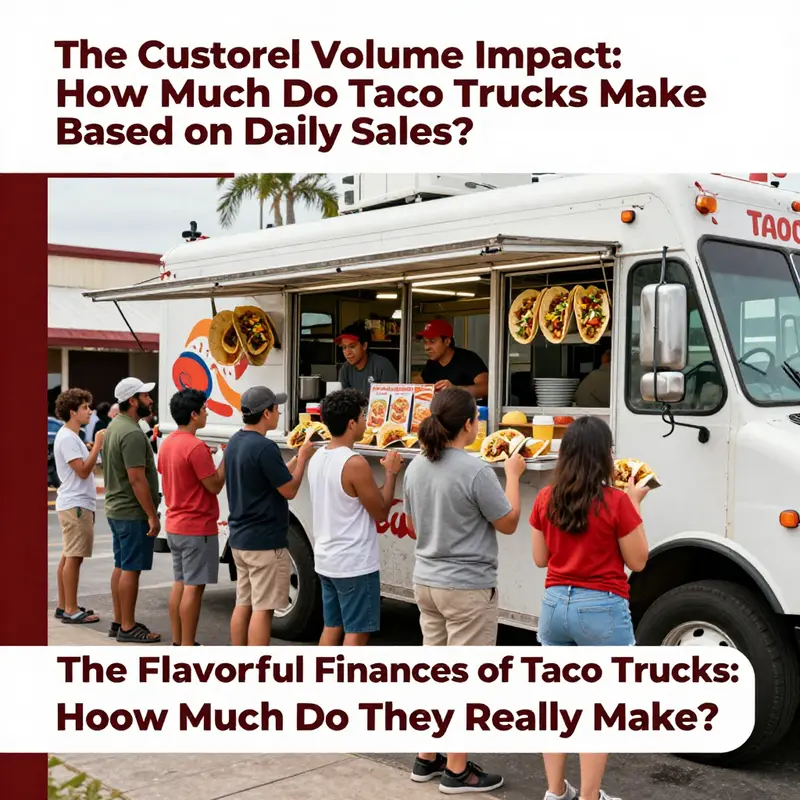
A taco truck is a moving economy in miniature. Its earnings hinge on daily foot traffic: the number of people who stop, sample, and pay. In dense urban settings, lunchtime crowds can swell lines and boost volume. Revenue scales with customer count, but costs also shape net profits. At $8 to $12 per meal, a truck serving 150 to 300 customers daily could see gross daily revenues in the $1,200 to $3,600 range. With food costs around 30 to 40 percent, labor, fuel, permits, insurance, and maintenance slicing into the rest, net margins commonly fall in the 10 to 20 percent band. A practical takeaway is to model daily volume across locations, set realistic price points, and manage costs tightly to convert volume into meaningful profit. Marketing, branding, and consistent service help sustain daily flow, while seasonality and events can tilt the balance toward higher or lower days. Long-term profitability comes from repeat customers, efficient sourcing, and disciplined operations rather than a single big day. Planning steps include: choosing high-footfall sites, aligning hours with peak crowds, offering value while protecting margins, and building a loyal customer base through quality and reliability. For those evaluating the venture, initial investment is substantial (vehicle, equipment, licenses, initial inventory), with payback varying by location and efficiency. A truck that maintains strong daily volume and tight cost control can reach solid monthly net profits, while lower-volume or higher-cost operations may struggle. In short: volume fuels revenue, price captures value, and margins depend on costs managed over time.
From Startup Costs to Monthly Profits: Decoding ROI for Taco Trucks
Taco trucks occupy the space between cooking and business. They offer mobility, fresh food, and a direct line to customers who want quick, tasty meals. But the question of profitability is not answered by a single number. It depends on decisions made long before the first taco is flipped: where the truck operates, how the menu is priced, what the operating model looks like, and how costs are controlled day to day. The path from startup to steady profits is shaped as much by strategy as by sizzling peppers.
The startup costs set the tempo. A taco truck doesn’t show up with one simple price tag. The initial outlay typically ranges from about fifty thousand to one hundred fifty thousand dollars, depending on whether the vehicle is new or used, its size, the kitchen equipment level, and the local market. A larger, newer vehicle with efficient cooking gear pushes toward the upper end; a smaller, used setup in a slower market sits toward the lower end. The upfront costs break into core categories: the truck itself, kitchen equipment, permits and licenses, insurance, initial inventory, and marketing to establish a base of early customers.
Revenue is variable but follows a practical pattern. Price points for a taco meal commonly land around six to twelve dollars, and a well-run truck can attract a steady stream of customers as brand and location mature. A typical busy week might see one hundred to two hundred customers per day; when multiplied by thirty days and by a six to nine dollar average, revenue climbs into the tens of thousands monthly. In strong locations, monthly revenue can push into the twenty thousand to fifty thousand dollar range, assuming solid branding, menu efficiency, and reliable access to customers. In smaller markets or shorter hours, revenue trends lower, even with tight cost control.
Costs and margins determine actual profit. Food costs often run in the thirty to forty percent range of revenue, reflecting the cost of fresh ingredients. Labor, fuel, vehicle maintenance, insurance, permits, and marketing are ongoing costs that scale with how much you operate and how efficiently you run. When costs are kept in line and volumes stay steady, net monthly profit might fall in the five thousand to fifteen thousand dollar zone in strong markets. The payoff timing depends on market conditions and how quickly you reach break-even, often within one to three years with careful planning.
The ROI reality is that there is no single price tag for success. High-traffic urban spaces offer higher ticket averages and volumes but also higher costs and more competition. Less predictable locations can still yield meaningful returns with disciplined pricing and a focus on repeat customers and event-based sales. A two to three year horizon to recoup the initial investment is a common frame in many analyses, though some operators realize profits faster by optimizing routes, expanding to more events, or offering signature items that travel well and generate word-of-mouth.
A practical roadmap for planning ROI starts with forecasting monthly revenue from expected daily customer count, average order value, and operating days. Then apply the core cost structure to estimate net profit, adjusting for seasonality and events. Build in a buffer for price changes, supplier shifts, and regulatory updates. Consider the operating model you want: fully mobile with lean fixed costs or semi-permanent with more predictable hours and potentially better supplier terms. A focused menu can improve margins and speed, while a broader menu can bring in more customers if handled carefully.
External factors matter: economic changes, tastes, weather, and local rules can all tilt profitability. A flexible pricing approach and a reliable cash flow buffer help weather downturns. Partnerships with events and local markets can provide recurring demand, while a rotating or seasonal menu can create excitement and repeat visits.
Bottom line: profitability rests on aligning location, menu, pricing, and efficiency. Start with a realistic budget and a practical revenue model, then refine as you learn what works in your market. The right vehicle, kitchen setup, and brand story accelerate customer adoption and financial viability. External resource: https://www.shopify.com/indonesia/blog/food-truck-costs-2025
Final thoughts
The journey of a taco truck from a startup to a thriving business is as rich and layered as the flavors it offers. Through understanding the potential revenue in high-traffic areas, scrutinizing operating costs, recognizing how daily customer volume affects sales, and evaluating the upfront investment, both taco enthusiasts and aspiring business owners can gain valuable insights. There is a world of opportunity within taco trucks that goes far beyond the delicious bites; it’s about cultivating a successful business filled with flavorful passion. Whether you’re planning to hit the road with your own taco truck or simply dreaming about a tasty meal, remember that behind every taco served is a story of hard work, strategic planning, and a zest for life!