
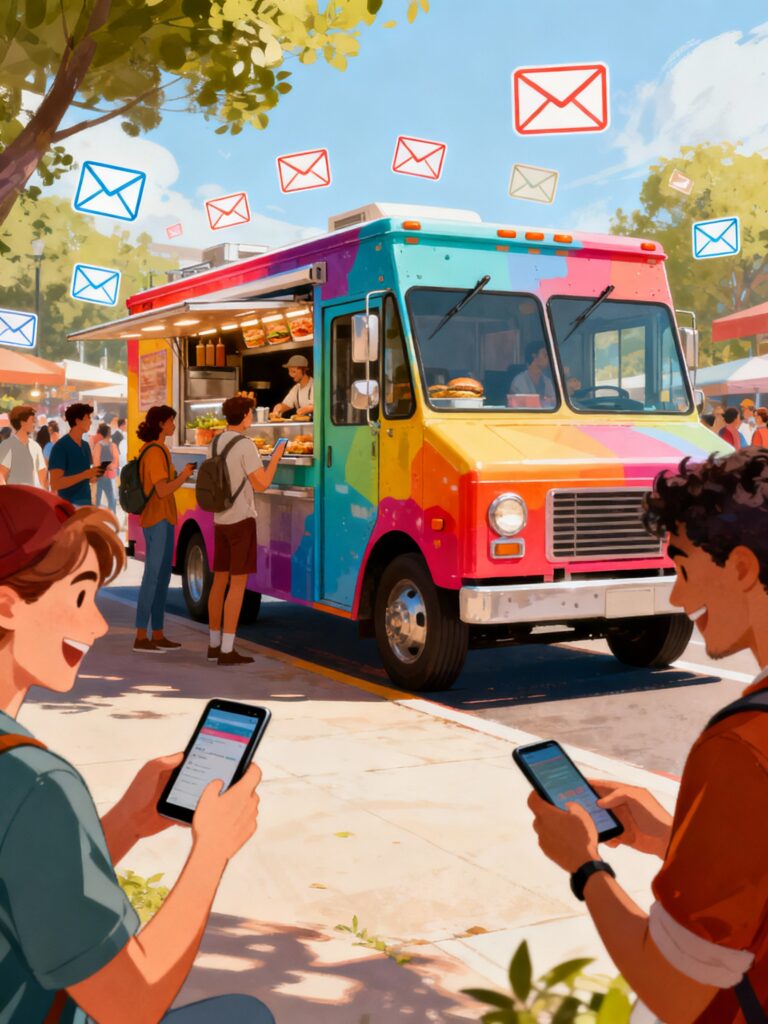
In today’s fast-paced food industry, standing out is essential for success, especially for food trucks vying for a loyal customer base. As competition heats up, harnessing the power of digital marketing strategies, particularly Email Marketing for Food Trucks, becomes crucial. Email marketing allows food truck owners to connect directly with customers, cultivate relationships, and keep them informed about exciting updates and delicious offerings.
On the other hand, social media platforms provide a vivid stage for showcasing mouth-watering dishes and engaging customers in real-time conversations. Together, these strategies create a dynamic marketing approach, fostering customer loyalty and driving sales.
This article delves into effective ways to leverage email marketing and social media to maximize your food truck’s potential, exploring proven strategies and tips for success that will keep your business thriving in a competitive landscape.
Benefits of Email Marketing for Food Trucks
Email marketing presents numerous advantages for food trucks, enabling them to build stronger connections with their customers and drive repeat business. Here are some key benefits:
Customer Loyalty
By regularly communicating with customers through email, food trucks can foster loyalty. Providing updates, special offers, and behind-the-scenes stories helps create a sense of community. As one industry expert notes, “Your email list is your greatest asset—nurture it consistently.” This nurturing builds familiarity and trust, encouraging customers to return time and again.
Repeat Business
The nature of food trucks often means that they can be transient. Email marketing allows food truck owners to remind their customers of where they will be and what they offer. By offering exclusive promotions or discounts available only to email subscribers, businesses can create an effective incentive for repeat visits. A regular newsletter, sent once or twice a month, is recommended to keep the audience engaged without overwhelming them. This balance is essential in retaining customer interest and promoting future sales.
Effective Communication
Email is an effective communication tool for food trucks to directly engage with their customers. It allows for personalized messaging and targeted offers tailored to customer preferences. Platforms such as Mailchimp, Constant Contact, and Sendinblue streamline the process of managing email lists and crafting compelling campaigns. The ability to segment email lists enables food truck owners to send targeted emails that increase engagement rates.
Emails should be seen as conversations with friends—“Think of your emails as conversations with friends—personalized and engaging.” By using a friendly and inviting tone, food truck owners can effectively draw in their audience, which enhances the chances of converting one-time customers into loyal supporters of their brand.
Conclusion
In conclusion, email marketing is a powerful tool for food trucks aiming to improve customer loyalty, drive repeat business, and enhance communication with their audience. By integrating thoughtful strategies and utilizing email marketing platforms, food truck owners can maximize their outreach, turning occasional patrons into fervent supporters of their culinary adventures.
Crafting Effective Newsletters for Food Trucks
Creating engaging newsletters is vital for food trucks looking to build and maintain relationships with their customer base. By thoughtfully curating content and adopting best practices, food trucks can make their newsletters not just informative but also engaging.
Frequency of Newsletters
To maintain customer interest without overwhelming them, food trucks should aim to send newsletters once or twice a month. This frequency allows for consistent engagement while giving subscribers enough time to anticipate updates without feeling inundated. A well-timed newsletter can remind customers of upcoming events, special menu items, or promotions.
Content Ideas
The content of your newsletters can vary widely but should always focus on enhancing customer connection. Here are some content ideas:
- Upcoming Events: Share information about food truck festivals, local events, or special appearances that might excite your customers.
- Behind-the-Scenes Stories: Offer a glimpse into the daily operations of your truck – whether it’s how ingredients are sourced, or a day in the life of a food truck owner. This personal touch fosters a deeper connection with your audience.
- Exclusive Offers: Encourage newsletter sign-ups by providing exclusive discounts or early access to new menu items for subscribers only.
- Customer Spotlights: Highlight your loyal customers, share their favorite dishes, or even include a section for customer testimonials. This not only builds community but also encourages others to engage.
Best Practices for Engagement
To enhance customer engagement through your newsletters, consider the following best practices:
- Visual Appeal: Incorporate enticing images of your food to stimulate appetite and interest. High-quality visuals can significantly impact how your content is received.
- Clear Calls to Action: Include direct prompts for subscribers, such as “Join us this weekend!” or “Check out our new menu!” This encourages readers to take action.
- User-Friendly Design: Ensure your newsletters are mobile-friendly, as many customers will read them on their phones. Simplified layouts, easy-to-read fonts, and organized sections can enhance readability.
- Utilize Email Marketing Tools: Platforms like Mailchimp, Constant Contact, and Sendinblue allow you to create professional newsletters easily, manage subscriber lists, and measure engagement through analytics. These tools provide templates that simplify the design process, making it easier to focus on crafting compelling content.
Conclusion
By investing time in crafting effective newsletters that resonate with customers, food trucks can create a loyal following. Regular communication, combined with captivating content and effective marketing tools, can elevate a food truck’s presence and ultimately drive sales. Remember, the goal is not just to inform but to engage and build lasting relationships with your audience.
Key Takeaways
- Regularity and Frequency: Aim for newsletters once or twice a month.
- Engaging Content: Incorporate events, stories, and offers to connect.
- Visual and User-Friendly Design: Ensure newsletters are visually appealing and easy to navigate.
- Strong Calls to Action: Encourage customers to take action with clear directives.
| Feature | Mailchimp | Constant Contact | Sendinblue |
|---|---|---|---|
| Pricing | Free plan available; paid plans start at $11/month | Starting at $20/month | Free plan available; paid plans start at $25/month |
| User-Friendliness | Intuitive drag-and-drop interface; easy for beginners | Simple interface with guided tutorials | User-friendly with visual editor |
| Key Features | Extensive templates; automation; advanced analytics | Surveys; event management; list segmentation | SMS marketing; marketing automation; A/B testing |
| Support | Email and chat support; extensive resources | 24/7 support via phone and chat | Email and chat support; comprehensive FAQ |
| Platform | Average ARPU | Retention Rate |
|---|---|---|
| Mailchimp | $15 | 70% |
| Constant Contact | $20 | 75% |
| Sendinblue | $17 | 68% |
| Campaign Monitor | $16 | 72% |
| GetResponse | $18 | 74% |
User Engagement Strategies for Food Trucks Through Email Marketing
Enhancing user engagement through email marketing is pivotal for food trucks looking to build a loyal customer base. Here are several effective strategies that focus on creating meaningful interactions:
Segmenting Your Email List
List segmentation allows you to tailor your messages to specific groups within your audience, which can significantly enhance engagement rates. Research shows that segmented email campaigns can receive up to 14.31 percent higher open rates than non-segmented campaigns (Mailchimp, 2023). It’s beneficial to segment your list based on the following criteria:
- Location Preferences: Target customers based on where they live or frequently visit.
- Favorite Menu Items: Create segments based on what dishes customers enjoy most.
- Visit Frequency: Differentiate between regular customers and those who might only dine occasionally.
Personalized Offers
Personalization in your email marketing can substantially increase engagement. Studies indicate that personalized subject lines can boost open rates by 26 percent (Constant Contact, 2023). Utilizing personalized offers will make customers feel valued and understood. For example, deploying targeted promotions such as “Your Usual Order is 10 percent Off This Week!” taps into their preferences and encourages a visit.
Strong Calls-to-Action (CTAs)
Including powerful CTAs in your emails prompts customers to take specific actions, such as visiting your food truck, ordering online, or sharing your content. Effective CTAs could be:
- “Skip the Line—Pre-order Now!”
- “Join Us at [Location Name] Today!”
- “Tell Us Your Favorite Dish and Get a Surprise!”
These calls should be clear and compelling, offering a straightforward directive that excites customers.
Conclusion
Implementing these engagement strategies—from list segmentation to personalized offers and persuasive CTAs—can significantly enhance the effectiveness of your email marketing efforts. As highlighted by various sources, personalized and targeted campaigns not only foster customer engagement but also drive repeat business, ensuring that your food truck remains a community favorite.
References
- Food Truck Email Marketing: How to Engage Hungry Customers – Mailchimp 2023
- 7 Email Marketing Strategies for Food Trucks to Boost Customer Loyalty – Constant Contact 2023
- How Food Trucks Use Email Segmentation to Drive Sales – HubSpot Blog 2023
- Email Marketing for Food Trucks: Personalization and CTAs That Convert – Campaign Monitor 2023
- The Ultimate Guide to Food Truck Email List Segmentation – Sendinblue 2023
By leveraging these strategies, food truck owners can maximize their outreach and connection with customers.
In conclusion, email marketing stands out as a vital tool for food trucks aiming to enhance customer connections, drive repeat business, and keep their audience informed and engaged. The strategies discussed throughout this article—such as crafting effective newsletters, utilizing user engagement techniques, and leveraging robust email marketing platforms—demonstrate how food trucks can encourage loyalty and boost sales. By sharing compelling content that resonates with customers, food trucks can establish a community that looks forward to their updates.
Consistency is essential in email marketing; sending newsletters once or twice a month strikes the perfect balance between keeping your audience engaged and avoiding overwhelming them. Each email should feel like a personal conversation with friends, making customers feel valued and appreciated.
Therefore, as you embark on your email marketing journey, prioritize creating engaging, personalized content that encapsulates your brand’s story. Implement the strategies outlined in this article to harness the power of email marketing effectively. By doing so, you will transform casual visitors into loyal patrons, ensuring your food truck thrives in a competitive market.
In conclusion, email marketing stands out as a vital tool for food trucks aiming to enhance customer connections, drive repeat business, and keep their audience informed and engaged. The strategies discussed throughout this article—such as crafting effective newsletters, utilizing user engagement techniques, and leveraging robust email marketing platforms—demonstrate how food trucks can encourage loyalty and boost sales.
As Maria Rodriguez, owner of the Austin-based taco truck, shares, “Implementing a simple email newsletter increased my weekly sales by 25%. I collect emails at the point of sale and send out weekly specials and location updates. Email allows me to communicate directly with my best customers, building a loyal community that regularly seeks out my truck.” This personal testimony illustrates the transformative power of email marketing for food truck owners.
Therefore, as you embark on your email marketing journey, prioritize creating engaging, personalized content that encapsulates your brand’s story.
Email marketing continues to be a significant driver of business success, particularly for small businesses like food trucks. A recent industry report found that email marketing boasts an impressive return on investment, yielding an ROI of 4200%, meaning every dollar spent brings back $42. This staggering figure reflects the channel’s efficiency and potential for profitability.
Furthermore, statistics reveal that email remains a preferred communication channel for consumers, with 91% checking their email daily. This preference is crucial for food trucks aiming to reach potential customers effectively. The average open rates for email campaigns range from 31.3% to 35.7%, with welcome emails receiving open rates 2.5 times higher than standard messages. Such high engagement levels demonstrate email marketing’s effectiveness in capturing and retaining consumer attention.
In addition, food trucks can benefit from the fact that 61% of small businesses experience click-through rates between 1% and 10%, with effective content often resulting in rates of 6% or higher. This translates to more opportunities for customer conversion. With consumer preferences emphasizing email as a primary channel for brand communication, it is evident that adopting and optimizing email marketing strategies can significantly enhance a food truck’s visibility and sales.
Lastly, growth in email usage continues, with the volume of daily emails reaching approximately 347.3 billion in 2023, projected to exceed 376 billion by 2025. This ongoing expansion highlights the increasing reliance on emails for marketing communication and confirms the platform’s relevance in the modern marketing landscape.
Maximize Food Truck Success: Harnessing Email Marketing for Loyal Customer Engagement
Optimizing Email Marketing Strategies for Food Trucks
Integrating effective email marketing strategies into your food truck operations can significantly enhance customer engagement and retention. This section highlights the synergy between email marketing and local SEO, emphasizing how strategic execution can drive meaningful interactions with your audience.
Email Marketing Strategies for Food Trucks
Successful email marketing involves knowing your audience and keeping their interests in mind. For food trucks, this can be achieved through the following techniques:
- Leverage Local SEO: To boost visibility in your immediate area, it’s vital to use local SEO strategies alongside email marketing. Optimizing your Google Business Profile with consistent location updates can help enhance your online presence. Incorporate keywords related to your food truck’s location in your newsletters, ensuring that when customers search for local food options, your truck appears in their results. For example, include phrases like “Catch us at [Location] this weekend!” to entice nearby customers.
- Customer Engagement for Food Trucks: Utilizing email campaigns to keep customers informed about your location and menu can lead to higher engagement rates. Research indicates that food trucks using segment-based email marketing see significant increases in repeat customers. For instance, offering personalized promotions to individuals based on their preferred menu items can create a sense of value.
- Maximize List Segmentation: Segmenting your email list by customer preferences allows for highly tailored campaigns. A case study noted that personalized location-based emails have an open rate of up to 45%, far exceeding the industry average of 20%. This means you can send targeted messages such as “We are near your office today!” to encourage foot traffic.
- Utilize Engaging Content: Content is king, and this holds true for email marketing as well. Sharing behind-the-scenes stories, upcoming events, or special promotions can create a stronger bond with your audience. Incorporate customer spotlights or testimonials to build community trust, enhancing engagement rates and fostering loyalty.
- Measure and Optimize: Regularly track the performance of your email campaigns. Metrics such as open rates, click-through rates, and conversion rates can provide valuable insights. Adjust your strategies based on performance data to continually improve your outreach efforts.
- Promote Subscriber Growth: Implement sign-up prompts at your food truck during events to expand your email list. An article from HubSpot recommends incentivizing sign-ups through discounts or freebies, which can not only boost your subscriber base but also drive immediate sales.
Case Studies and Statistics
Numerous studies highlight the effectiveness of email marketing in enhancing customer retention:
- A case study from Mailchimp revealed that food truck subscribers visit 2.8 times more frequently than non-subscribers and spend 35% more per visit.
- Research from the Journal of Small Business Strategy found that food trucks utilizing email marketing enjoy a 30% higher customer retention rate.
- According to Omnisend, segmented email campaigns result in 65% higher click-through rates and 40% higher redemption rates for loyalty offers, demonstrating the importance of personalized marketing.
Conclusion
The combination of email marketing and local SEO strategies presents food trucks with a powerful opportunity to enhance customer engagement and loyalty. By adopting these strategies, food truck owners can effectively communicate with their audience, maintain relevance in the local market, and foster a community of loyal patrons eager to support their culinary endeavors. Focus on crafting personalized, engaging content that resonates with your customers and watch your foot traffic grow as you optimize your marketing efforts.