
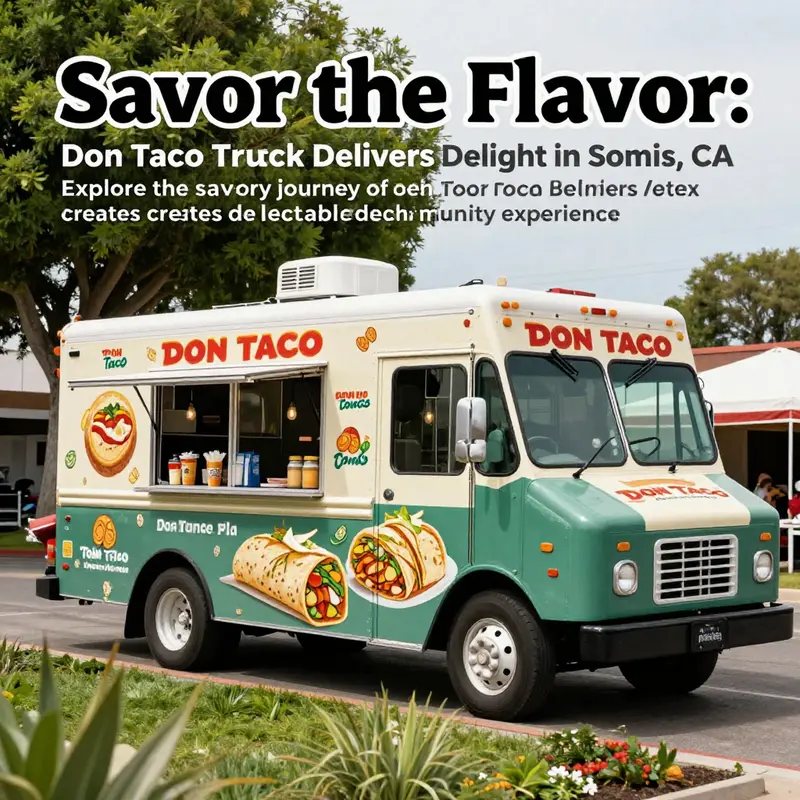
Nestled in the warm embrace of Somis, California, the Don Taco food truck is a flavor-packed delight that has captured the hearts of taco enthusiasts and cuisine lovers alike. Known for its mouth-watering burritos and commitment to fresh ingredients, this mobile kitchen not only serves delicious food but also fosters a thriving sense of community. As we dive into the operational dynamics, offerings, and the positive influence the food truck has on its clientele, we’ll uncover what makes Don Taco a standout in the bustling world of food on wheels. In the chapters that follow, we’ll explore the food truck’s operations and distinctive menu, compare its appeal with similar establishments, and highlight its reception within the community to paint a complete picture of Don Taco’s vibrant presence in Somis.
Under the Somis Night Sky: The Craft, Community, and Quiet Rhythm of Don Taco’s Somis Food Truck
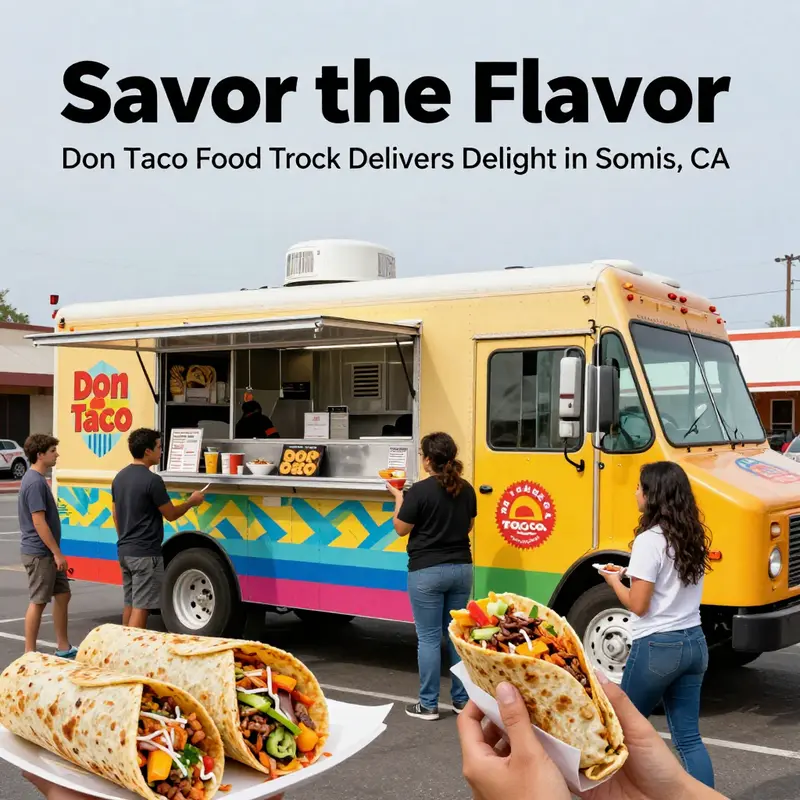
When the sun slips behind the oaks and a cool breeze brushes the lanes of Somis, a bright red-and-gray food truck slides into place on 3861 Somis Rd. It arrives not with fanfare but with the steady hum of a neighborhood ritual. The truck’s presence turns a narrow stretch of road into a small, welcoming hub where neighbors linger for a moment longer than the usual rush of a late afternoon. Don Taco, as the locals say, has learned to earn trust not just through the warmth of its tortillas but through the predictability of its hours and the consistency of its flavors. The routine is simple and reliable: a window of service runs from early evening into the night, typically from five forty-five to ten o’clock. The timing matters as much as the food because in this slice of Ventura County, the evening air invites families and workers to unwind with something hot, fresh, and familiar after a long day. The rhythm of the truck mirrors the rhythm of the community it serves, and that mirroring matters. It creates a short, shared ritual in which strangers become acquainted through the exchange of meals and small conversations about weather, harvests, and weekend plans. The physical footprint of the operation—the chrome wheels, the chalky menu boards, the little flame that flickers behind the steam—tells a story of mobility lived with intention. It is a lean setup, designed for speed and freshness, not spectacle. Yet in its restraint lies a kind of confidence. The truck is a mobile kitchen that respects the craft of cooking and the cadence of a small town, a place where meals are prepared not in hurried corners of a commercial strip but under open skies where the stars begin to appear and the night air carries the smoky scent of seasoned meat and citrus.
The address anchors the truck in Somis, but the character of its operation comes from a careful balance between tradition and practicality. The team works with a quiet efficiency that makes the line feel almost ceremonial rather than transactional. Behind the simple ordering window, cooks move with practiced ease, turning raw ingredients into plates that carry memories of street markets and family gatherings in distant regions of the country. The process is not flashy; it is measured and attentive. Each dish is assembled with a sense of purpose, with attention paid to temperature control, the payoff of a crisp edge on a well-seared exterior, and the harmony of spices that do not overwhelm the meat’s natural character. The team’s approach to freshness is tangible. The produce looks bright, the meats glisten with their own moisture, and the aroma rises in gentle waves that invite people to pause and consider the meal as an event rather than a quick bite.
The menu, described by visitors as a showcase of traditional Mexican flavors, leans into slow cooking, marination, and careful grilling. The offerings emphasize a spectrum of textures and contrasts—from tender, fall-apart pork to marinated pork roasted on a vertical spit for height and caramelization, and from the char of a well-marinated beef cut to the more adventurous edges of the lineup that push against familiar comfort foods. There is a deliberate openness in the choices, a sense that this is a place where technique serves flavor without the pretension of experimentation for its own sake. The result is food that feels both rooted and accessible, a virtue that matters when the goal is to satisfy a broad spectrum of tasters, from families seeking familiar meals to food enthusiasts chasing a new, honest bite after a long day. The cooking methods are straightforward and honest: slow cooking to tenderness, controlled roasting to achieve a crust that carries the right amount of smoke, and precise grilling to seal in juices without sacrificing bite. The plan appears simple, yet its effect is layered. Each bite offers a familiar profile, but the aroma and the texture carry a note of careful refinement that elevates the experience above the ordinary street-taco encounter.
In this environment, the personality of the owner emerges as a key ingredient in the Don Taco story. The owner is widely recognized as approachable and warm, a neighborly presence who greets regulars by name and offers a smile that seems to acknowledge the ordinary joys of a local’s daily life. That warmth does more than welcome customers; it builds trust. When people walk up to the window, they know they are seen. This becomes especially important in a place where the menu rotates through familiar staples and a handful of more adventurous items. The owner’s friendly demeanor lowers the barrier for someone trying a new preparation, easing the moment when a curious first-timer decides to deviate from the safe choice. In communities like Somis, that sense of welcome is not a mere courtesy; it is a social glue that helps a food truck transition from a temporary pop-up to a reliable neighborhood option.
Pricing is a critical element of the Don Taco formula as it unfolds in Somis. The market for late-evening meals in this region benefits from a balance between affordability and quality. The truck’s pricing strategy reflects an understanding of its audience: families stopping by after activities, workers who have wrapped up an evening shift, and a stream of neighbors who stop in on foot or by bicycle as a post-work ritual. The care in the preparation is clear, and the cost remains accessible, allowing more people to choose a fresh, flavorful meal without feeling a financial pinch. The value proposition rests on several pillars: the quality of ingredients, the skill with which they are prepared, and the simplicity that keeps the price point within reach. This is not fancy dining in the sense of a brick-and-mortar restaurant with a long bill; it is a practical and honest option for a night meal, one that respects the pocketbook and still delivers a satisfying, well-made plate. The combination of fresh ingredients, careful cooking, and fair pricing makes Don Taco a dependable choice in a town where choices at dusk can multiply quickly and where a good bite makes the difference between a long drive home and a moment of contentment in a familiar place.
A crucial part of the Somis experience is how the truck fits into the broader pattern of local life. Its operating hours align with a late-population window when people are finishing chores, attending activities, or just seeking a pause before the evening quiet settles in. The location—quiet, edge-of-town roads with a line of trees along the shoulder—contributes to a sense of belonging rather than isolation. The truck’s presence becomes a brief community focal point, a place where people trade the latest news, a recipe tip, or a kid’s imagined future as a family cook. In many ways, the Don Taco operation is a study in how simple logistical choices—location, hours, and a friendly face—can transform a mobile kitchen into a civic space. The natural flow of customers, many of whom return week after week, creates a small but meaningful culture around the truck. People learn to anticipate the precise moment a familiar scent drifts along the road and the sound of sizzling fat signals that the window is open and the service is about to begin. The ritual has a quiet power: it anchors a local identity and lends a sense of continuity to the lives of people who know where to find a reliable late-evening meal when the day has ended but the appetite remains.
The Somis operation also functions as a microcosm of how a mobile food business can sustain itself with grace and consistency. There is a discernible pride in the way the team handles each order, ensuring that even a busy night moves with deliberate calm. The process reflects a philosophy of service that values the individual as much as the meal. A customer may arrive with a specific craving or a story about a long day, and the staff respond with a combination of efficiency and openness. The goal is not merely to fill a plate but to offer a moment of satisfaction that resonates beyond the bite. In this sense, Don Taco’s Somis truck exists at the intersection of craft and community. The craft is evident in the careful technique and the careful balance of flavors; the community is evident in the relationships formed with neighbors who return, in the sense of trust that grows with each visit, and in the small talk that makes the line feel less like a queue and more like a shared evening ritual.
Though the Somis truck stands as its own entity, it shares a broader network of similarly named ventures across the United States. The landscape across Georgia, Illinois, and even Moldova includes establishments carrying the Don Taco name, though these are distinct businesses with their own menus and models. The Somis truck’s focus remains deeply local: fresh, affordable, and intimate in its approach. It is a reminder that a food truck can become more than a place to eat; it can be a neighborhood landmark. In Somis, the truck tailors its offerings to the moment—what’s in season, what works best for late-night appetites, and what the local palate has learned to expect from a warm, fragrant kitchen on wheels. There is no unnecessary flourish in the presentation; instead, there is a quiet confidence that comes from consistency and from listening closely to the needs of a small urban-rural community that appreciates both the romance of street food and the honesty of a well-prepared meal.
For readers who may be curious about the practical path that makes a mobile taqueria successful, the broader conversation about how to choose and manage a food truck becomes relevant. A good starting point lies in understanding how the right setup can unlock a steady flow of customers while maintaining quality and control. This is not about chasing trends but building a dependable performance over time. In the context of Somis, the Don Taco operation demonstrates that a well-chosen location, a predictable schedule, and a welcoming ethos can yield a loyal following even in a crowded market. It is a reminder that the heart of a food truck’s appeal lies not only in its recipes but in the consistency of its presence and the warmth it offers to the people it serves. The Somis truck thus stands as a valuable example of how a mobile kitchen can become a fixture in a community: a place to unwind, to share a quick, flavorful meal, and to feel connected to neighbors who pass through the same nightly routine.
As this chapter threads together location, timing, technique, and personality, it also invites readers to consider the larger implications of mobile dining. The culinary possibilities offered by a well-tuned truck operating in a small town are immense when seen as a living part of the community fabric. A truck can achieve more than speed and volume; it can cultivate trust, create moments of delight, and contribute to a sense of place. The story of Don Taco in Somis is not simply a catalog of what is on the menu; it is a narrative about how a simple late-evening meal can become a shared experience, how a neighborhood can welcome a mobile kitchen as part of its daily life, and how the careful balance of affordability, quality, and human warmth can transform a roadside stop into a cherished memory for many who pass by on their way home.
For those reading who might be contemplating a similar venture, a practical reminder sits at the heart of this account. The Somis truck shows that success comes from knowing what the local audience values: approachable meals that honor tradition, offered with a level of hospitality that makes every customer feel seen. It is a model built on consistency, rather than constant novelty, and built on a commitment to staying connected with the community it serves. In that sense, the Somis Don Taco is more than a food truck; it is a neighborhood gathering point, a place where the scent of warm tortillas and slow-cooked meats becomes a familiar welcome at the end of a day. And as the night settles in and the lights along the storefronts glow softly, the truck remains a discreet beacon of good food and good company, a modest but meaningful thread in the fabric of Somis life. If one asks what makes a mobile kitchen endure, the answer isn’t merely in the recipes or the equipment. It lies in the balance between craft and care, in a menu shaped by tradition yet accessible to a broad audience, and in a presence that makes a community feel seen, valued, and hungry for more memories built around a simple, well-made meal. For anyone curious about the practical and philosophical aspects of launching and running a successful food truck, the Don Taco Somis example offers a grounded, human-centered perspective that rings true in every bite and every friendly exchange at the window. To learn more about what goes into choosing the right path for a food truck, you can explore further here: Choosing the right food truck.
Authenticity on Wheels: Don Taco Food Truck’s Late-Night Edge and the Comparative Landscape of Mobile Mexican Cuisine
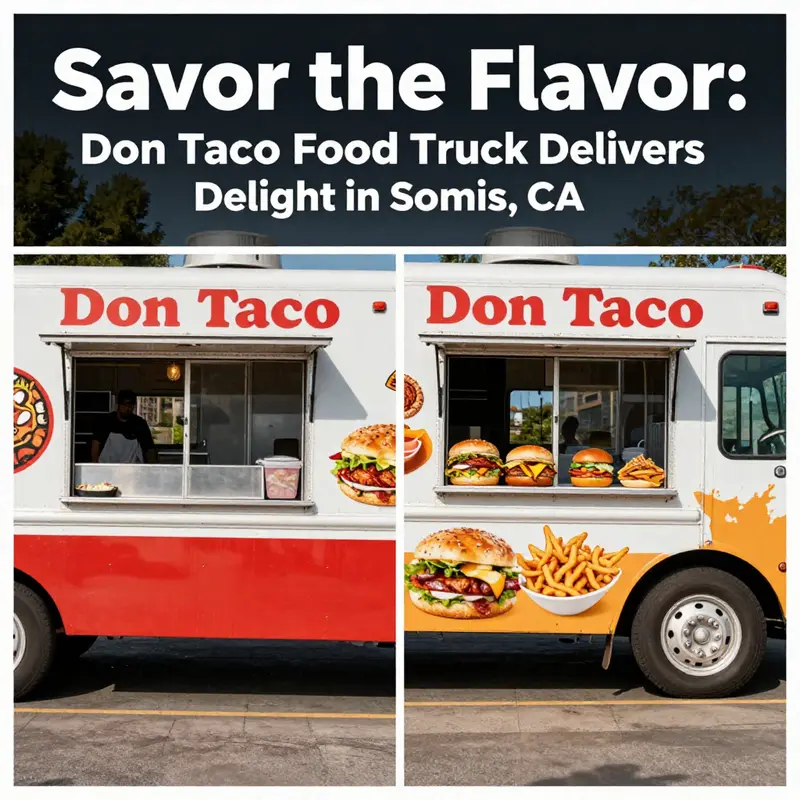
In the rolling hours between dusk and late night, a small, bright truck with a big name—Don Taco—feeds a distinct demand in the Moorpark-Somis corridor of Ventura County. The Don Taco food truck is more than a service point for hunger; it is a compact stage where authenticity, timing, and a community-anchored menu converge to form a recognizable experience. Its operating window, typically from 5:45 PM to 10 PM, intentionally aligns with after-work routines and late-evening cravings in a region that often slows as the sun lowers. The result is a culinary moment that feels both intimate and practical: you can pick up something freshly made, flavorful, and distinctly Mexican without having to travel far from home or work. This is not merely street fare; it is a deliberate positioning that leverages the rhythms of local life. The late-night niche Don Taco inhabits is not common among every mobile vendor, and that rarity matters. In many parts of the country, fresh, authentic Mexican food after dark is a point of exception rather than rule. Don Taco’s ability to remain open later than many peers in nearby commercial strips or parks positions it as a reliable option when the urge for a well-made burrito or a satisfying, simple plate arises after a long day. This timing is not an accident but a strategic element of the brand’s story, one that reflects a nuanced understanding of what it means to operate a mobile kitchen in a place where the daily cycle dips and then reawakens around dinner and late-evening tides of appetite.
Authenticity is the core differentiator that Don Taco consistently communicates through both its menu and its procedure. When a consumer walks up to a bright truck, the expectation is not merely convenience; it is trust—the trust that the ingredients are fresh, the flavors sincere, and the preparation faithful to the cuisines that inspire them. The emphasis on authentic Mexican fare—tacos, burritos, and other staples prepared with a respect for tradition and a respect for the local palate—gives the truck more depth than a generic “taco stand” could ever claim. In an evolving marketplace of mobile vendors, where a handful of operators chase novelty, Don Taco anchors itself in a culinary lineage that resonates with families, workers, students, and visitors who value quality and heritage as much as speed.
This blend of authenticity and accessibility has helped cultivate a loyal, recurring crowd that returns not just for meals but for a reliable experience. The loyalty is reinforced by consistent service and a straightforward value proposition: good, fresh Mexican food at a price that makes sense for everyday dining. The emphasis on fresh ingredients and flavorful preparation reinforces the perception that the truck is more than a rotating food option; it is a dependable resource in a region where options can be sporadic and, at times, underwhelming. In Don Taco’s world, flavor is not an afterthought or merely a marketing hook. It is an operational discipline that informs every decision—from shopping for produce to assembling a burrito and serving it hot from the window.
To understand Don Taco within a broader landscape of mobile food, it helps to acknowledge how the operation compares with other mobile vendors that populate online marketplaces and industry discussions. A substantial portion of the mobile food ecosystem, as reflected in supplier catalogs and B2B marketplaces, centers on the sale of equipment, trailers, and turnkey units. These platforms highlight features like stainless-steel construction, customization options, warranty terms, and payment guarantees. They speak to the logistics of building a vehicle and a brand from the ground up, often toward a vision of scalability and replication. Yet these supplier-focused narratives tend to miss a crucial distinction: the consumer experience—the direct connection between a chef, a menu, and diners in the community. A vehicle, even the most impeccably designed and engineered, is not the story by itself. The story is in how the vehicle serves a menu that feels rooted in place, a kitchen culture that invites people to linger a moment longer than a typical fast-casual stop, and a brand identity that remains coherent across hours and seasons.
What emerges when you place Don Taco in the context of these mobile-supply-oriented conversations is a reminder that the most successful mobile concepts rarely hinge solely on the vehicle. They hinge on a cohesive blend of culinary authenticity, brand consistency, and a mode of engagement that echoes through the local environment. Don Taco demonstrates this blend through several converging strands. The first is a menu that remains true to its influences while allowing for the local palate to shape the familiar offerings. The second is operational reliability: a schedule that diners can trust, a process that delivers a predictable quality, and a service approach that respects customers’ time. The third is community integration: a presence that becomes part of the neighborhood routine, where regulars know they can count on the truck as part of their evening or late-night ritual. In a practical sense, these elements translate into repeat visits, word-of-mouth referrals, and a brand aura that feels personal rather than purely commercial.
The distinction between Don Taco and many other mobile operators is not merely about being a truck that serves tasty food. It is about the way the brand frames its existence in the local economy and in the daily lives of its patrons. The operation relies on an authenticity that can be perceived through aroma, color, texture, and the careful assembly of each burrito or taco. It is reinforced by a level of service consistency that does not waver with crowd size or late hours. And it is supported by a strategic alignment of hours with the needs of the community—a time window that is long enough to accommodate dinner and late-night cravings but compact enough to maintain quality control and freshness. In short, Don Taco’s success is not just in what is cooked but in how the brand is experienced—day by day, night after night.
In the broader debate about mobile dining, another important insight concerns the identity of the brand itself. Don Taco operates as a branded cooking identity with a clear name, a set of expectations, and a recognizable sign that travelers and locals alike can spot from a distance. This clarity of brand assists in building trust, which is essential when a customer is deciding whether to queue up at a window and wait for a well-made meal after a long day. By contrast, many suppliers and similar listings on B2B marketplaces describe the vehicle first and the potential for a business concept second. They emphasize the instrument of trade—the trailer, the power, the stainless steel—without necessarily conveying how that instrument translates into a living dining experience for customers. The difference is meaningful because, in the end, the customer’s choice to return depends less on the car or truck they see and more on the meal they receive, the warmth of the service, and the sense that the operation cares about its neighborhood.
The Somis-Ventura County context further amplifies the Don Taco story. In this region, the truck’s late-afternoon-to-evening format taps into an existing rhythm of lingering social life and family routines that extend beyond a standard dinner hour. The area’s pace can be sleepy in the early evening, but it often perks up as schools finish, offices clear out, and neighborhoods settle into a more relaxed pace. Don Taco’s window, which begins well before typical late-night crowds in some urban centers, is a deliberate choice to position itself as a dependable, friendly option for people who still want something fresh and satisfying after a long day. The distance from a major metropolitan dining hub amplifies the truck’s role as a local stalwart rather than a passing novelty. This is not simply about the convenience of mobile dining; it is about the credibility that comes from showing up consistently, honoring the local palate, and delivering a product that earns its reputation through flavor and character rather than marketing alone.
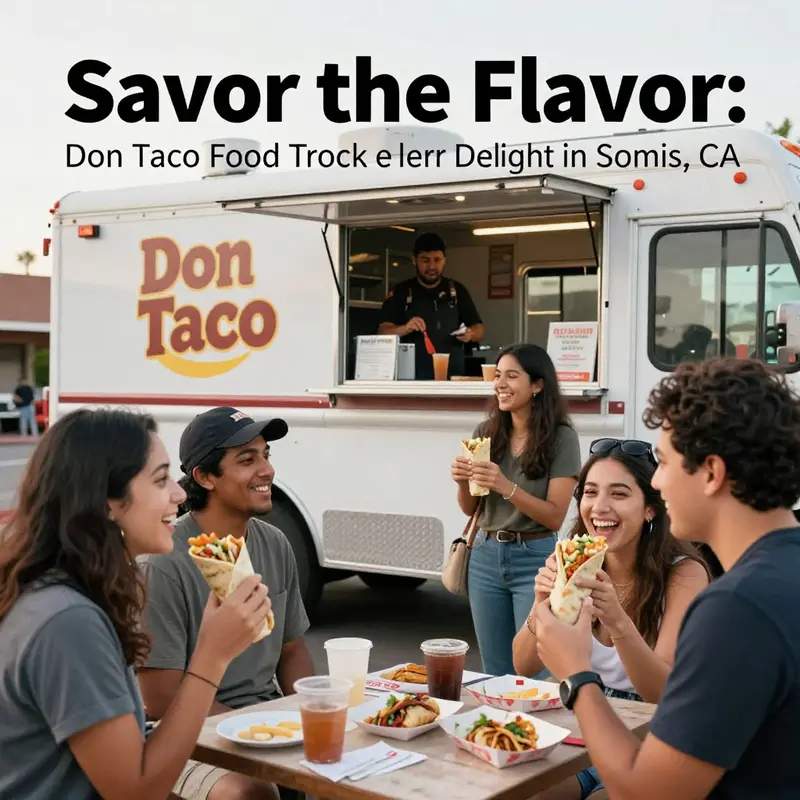
An important nuance in the Don Taco narrative is how authenticity is reinforced through community engagement, not merely through the plate. The truck’s interactions with patrons—greeting familiar faces, remembering preferences, and providing a window for conversation about ingredients and preparation—build a sense of belonging. This relational fabric matters as much as the menu on the board. It elevates the dining moment from a quick bite to a shared experience that can anchor a family’s routine, a student’s late study-break, or a worker’s relief after a shift. In this sense, the truck functions as a mobile gathering place, a point of local pride that travels with the neighborhood’s memory as much as with its traffic patterns. Such social currency is difficult to achieve through a generic, movement-focused business model that prioritizes speed over connection.
From a strategic standpoint, the Don Taco model demonstrates how a mobile operation can maintain brand integrity while remaining adaptable to a shifting competitive landscape. Authenticity cannot be faked; it must be baked into every decision—from sourcing to recipe choices, from kitchen practices to the way orders are fulfilled. The operator’s willingness to stand behind a consistent, high-quality product, even during peak service times, signals a commitment that extends beyond mere profitability. It signals to the community that the truck is here to stay, to listen, and to improve. In an industry where volatility—weather, staffing, permits—can threaten consistency, the choice to front-load quality and reliability pays dividends in trust and repeat business. Don Taco embodies this philosophy through a deliberate alignment of culinary craft, customer care, and local presence.
To place this within a wider frame, one might consider how a consumer-facing brand like Don Taco differs from the primary value proposition offered by many online marketplaces that list mobile units for sale. Those platforms describe capabilities that could enable an entrepreneurial dream: the ability to customize, to warranty, to finance, to scale. Yet the consumer’s direct experience—the flavor, the atmosphere, the rate of service, the sense that someone is cooking for you with pride—remains the heart of any successful mobile operation. The Don Taco story suggests that the strongest competitive advantage is not solely the vehicle’s design or the trailer’s features but the synergy created when authentic cooking meets reliable service and a genuine connection to place. In the long run, the vehicle becomes a means to an end—the end being a trusted, beloved local dining option with a clear identity.
There are other places with similarly named ventures, including restaurants in Knob Creek, Georgia, Carbondale, Illinois, and even a Mexican dining venue in Chișinău, Moldova. Each of these entities occupies its own space in the broader tapestry of Mexican-and-Mellow-Cali-inspired cuisine, but none of them defines the Don Taco experience in Somis. The distinction is not merely geographic; it is the difference between a branded, resident kitchen on wheels that accompanies a community through its evenings and a separate dining establishment whose character and service are shaped by a different market dynamic. The Somis truck, in its continuous wearing of authenticity, yields a narrative that is less about a single dish and more about a philosophy: the belief that late-night, well-crafted Mexican food can become an anchor for a neighborhood’s social life. The strategic takeaway for aspiring operators is understated but powerful. While a well-designed truck matters, the real differentiator lies in what happens when the window opens: the flavors that emerge, the consistency that patrons rely on, and the way the operation integrates with the life of the community it serves.
The power of this approach is also visible in the brand’s ability to translate online impressions into real-world visits. Visual references and social media posts can illuminate the craft and the care behind each item, but they must be matched by the actual dining moment. Don Taco’s enduring appeal demonstrates that when authenticity and location collaborate with a dependable schedule, the result is a memory that fans want to repeat. In this sense, the truck’s narrative is a case study in the value of combining culinary tradition with practical, neighborhood-focused operations. The model works not because it promises novelty at every turn, but because it delivers continuity—an honest, flavorful meal that respects both its Mexican roots and the Southern California moment in which it appears.
For readers and practitioners who want to explore similar paths, a useful route is to consider how the choice of vehicle interacts with the broader strategy of culinary authenticity and community engagement. The mechanical and aesthetic aspects of the truck are part of the stage, but the script—the menu, the voice of service, and the cadence of hours—determines whether the audience returns. The Don Taco example invites a broader reflection: in a world increasingly saturated with food trucks, the strongest performers are those that make a simple promise well—plates that taste like they came from a kitchen, a commitment to timely service, and a presence that feels earned through local ties rather than borrowed from a catalog. This is the core of the comparative story, a narrative that may guide future operators in building something that endures beyond the trend cycle.
Internal linking into this ongoing dialogue about choices in the mobile-food world is instructive. For those contemplating the leap into the food truck life, the idea of choosing the right vehicle remains essential, but it should be framed as part of a larger system of quality and community. The careful pairing of a solid vehicle with a well-curated menu and a sincere connection to the neighborhood creates a compound advantage that is hard to replicate with a generic concept. A practical consideration in this equation is how a new operator frames value: the cost of the truck is only one line item; the longer-term return comes from the ability to sustain quality, to scale responsibly, and to nurture customer relationships that turn first-time visitors into regulars. To explore this broader approach, consider the resources that discuss how to choose the right equipment and how to align capital investment with market expectations. Choosing the right food truck offers a framework for evaluating these factors in tandem with branding and menu design, reminding readers that the core of mobile dining lies at the intersection of craft, consistency, and community.
External reference: https://www.dontaco.com
null
null
Final thoughts
The Don Taco food truck is more than just a culinary stop for burrito lovers in Somis; it is a cherished hub that nourishes both the body and community spirit. With its dedication to fresh ingredients and bold flavors, it uplifts not only diners but also contributes positively to the local culture. By understanding its operations, unique offerings, and the warm reception from patrons, we recognize the impact of Don Taco in transforming casual dining into an engaging and community-focused experience. As taco lovers continue to flock to this delightful food truck, the spirit of Don Taco serves as a reminder of the joy food can bring when shared among friends and neighbors.